The Yowani Choctaw Saga
Copyright 2025 - Ishkatini Studios
Castle Hills, Texas
All Rights Reserved
The Yowani Choctaw Saga is a collection of three historical novels. Together they trace the journey of the author's family removed from Mississippi to the Choctaw Nation only to be dispossessed again by actions of the Federal Government. It is a story of courage, resistance and hardship traced over a 130 years of history.
Books Included in the SagaEach individual book is available in eBook, Paperback and Hardcover book format and as an Audiobook on Amazon.
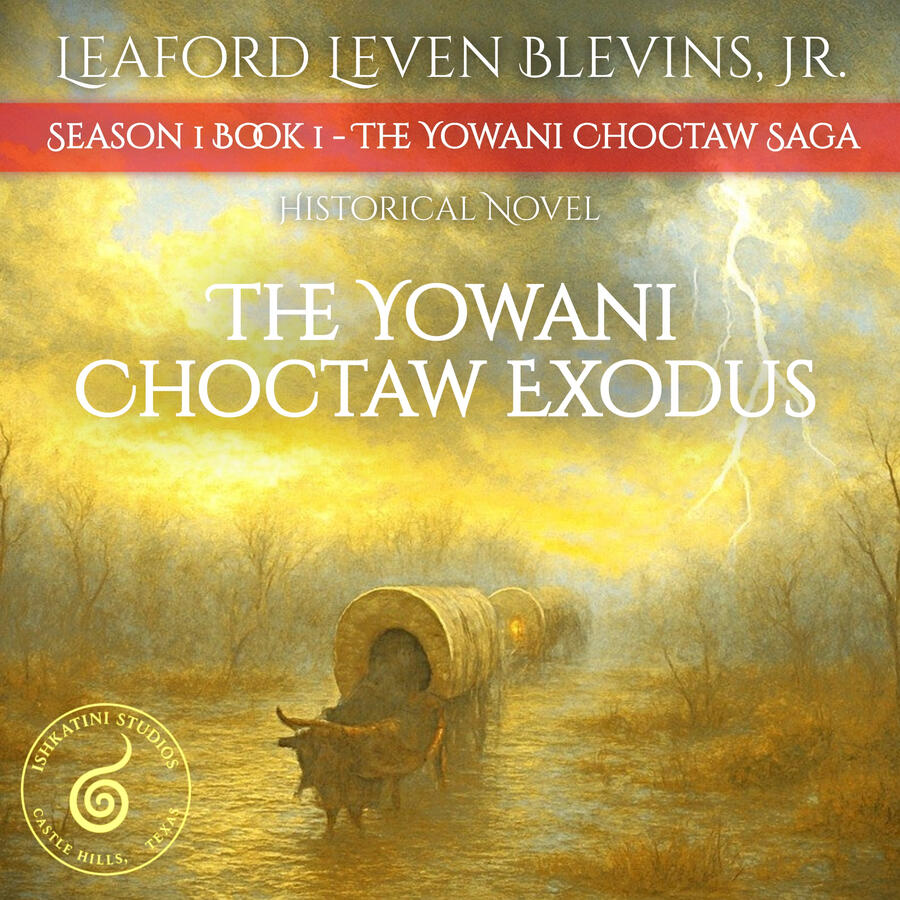
Book 1- The Yowani Choctaw Exodus
Narrated by Ken Snow
Book 1 - Long before Oklahoma became a state and long before the United States understood the depth of its own promises, a small band of Choctaw families known as the Yowani stood on the edge of history. Their homeland lay in the deep forests and river valleys of Mississippi and Alabama, where their ancestors had lived for millennia. But with the coming of removal, treaties written under duress, and the relentless pressure of American expansion, the Yowani found themselves confronted with a question that would define generations:
Stay and risk disappearance, or leave and risk everything else?
Book 2 - William Clyde Thompson
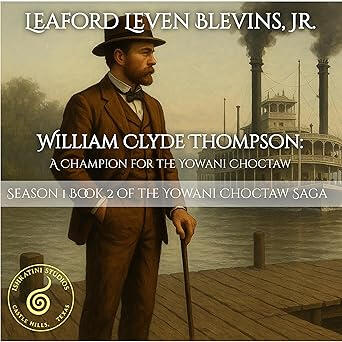
Narration by Mike Hennessy
Book 2 - Around 1840, both parents of the infant William Clyde Thompson died near Fort Towson. His grandmother, Margaret McCoy, took responsibility for his care, with her brother James McCoy acting as a father figure. Oral tradition and family record describe a journey that Margaret, her husband, and James made to Fort Towson (often called Fort Thiessen in older references) to claim and raise the orphaned child. This moment defined Margaret’s role as the matriarch of the Yowani line — stepping in to preserve continuity of family and clan.
William grew up effectively as her son. This is his story.

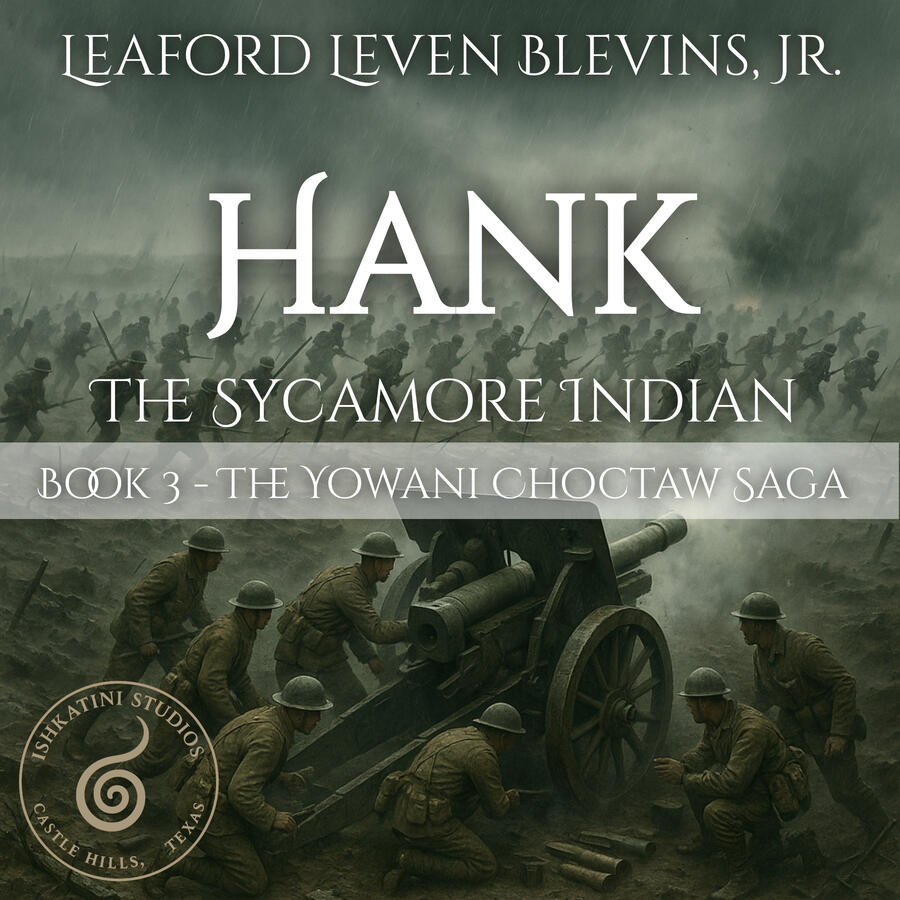
Book 3 - Hank, The Sycamore Indian
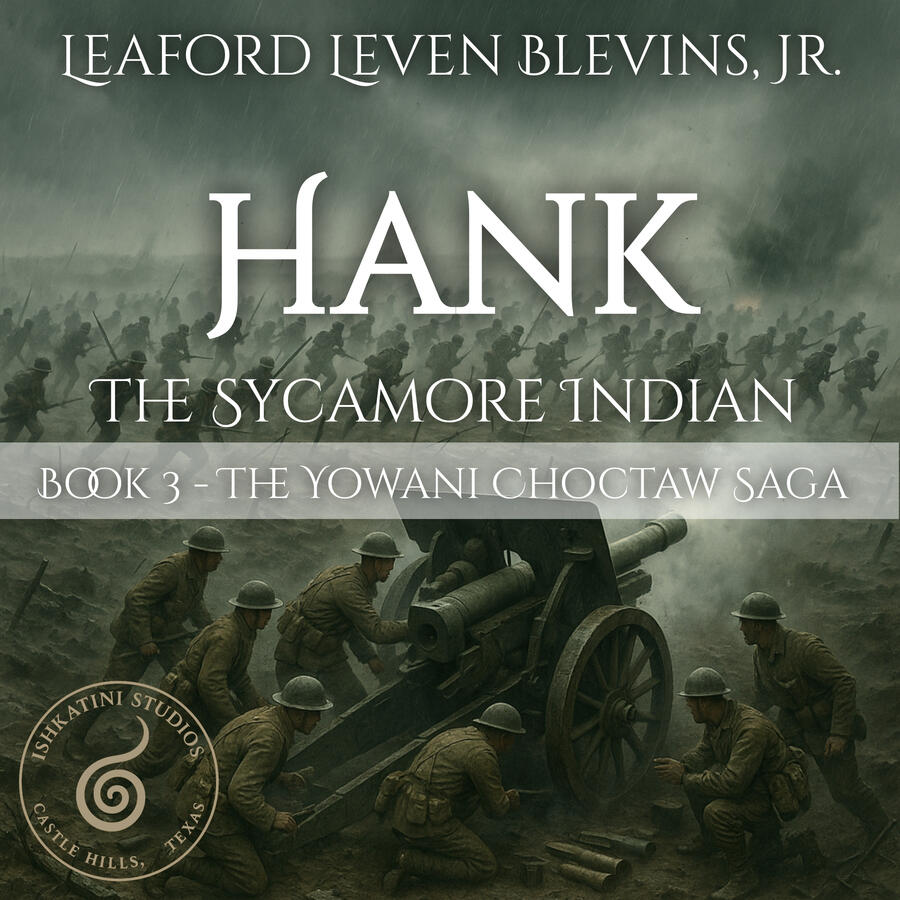
Narration by Ron Knezek
Book 3 - Hank’s story was preserved just enough to invite retelling.In writing about him, I have relied first on the facts — the records, the documents, the photographs, the gravestones. But where the record falls silent, I have allowed myself to lean on another kind of inheritance: the subtle echo of family, of DNA, and of kinship that shapes how we understand those who came before us. My intent is simple: to honor an ordinary man whose life has meaning precisely because it was never judged important enough to record in detail. By telling his story, I hope to give him — and those like him — a place in history, however modest, that will not be forgotten.
About The Author
Leaford Leven Blevins, Jr. is a proud blood citizen of the Choctaw Nation of Oklahoma. This series captures the story of the relocation of his sixth great grandmother, a matriarch of the Creek Wind Clan, to the Choctaw Nation, in what is now Oklahoma, in the mid 1800's. What follows is a story woven from the scraps of history that persist in the written record, verbal history passed down, and his family's lived experience.Blevins is a graduate of The University of Oklahoma, and has spent his adult life in Texas, California and Oklahoma. His architectural practice has included projects in the US and the Pacific Rim.His other literary work includes the highly successful mystery novel series, under the pen name, D. Champfleur. The Lighthorse Mysteries, They are set in the Chickasaw Nation. Visit TheLighthorseMysteries.com for more information.He is also the author of a series of essays and critical professional writings on architecture practice, based on his life's work, weaving indigenous architectural sensitivities into modern day architectural practice, published as Architecture Without A Scar.

References and Resources
Origins of The Saga
The Legal Architecture of Removal
How the Choctaw Exodus Was EngineeredWhen most people think about the removal of Native nations from the southeastern United States, they picture a single event: a forced march west, carried out under military supervision, remembered today as the Trail of Tears. That image is true as far as it goes—but it is incomplete. What it obscures is the far more deliberate process that made removal possible long before the first family was forced from its home.What we present here is not a retelling of tragedy, but an examination of how law itself was used to produce it.The Choctaw Exodus was not the result of frontier chaos, spontaneous violence, or an unavoidable clash between cultures. It was the outcome of a carefully staged legal campaign, unfolding over more than a century, in which sovereignty was dismantled step by step, land was transformed into property, and citizenship was granted only after meaningful power had been stripped away.Removal was not a single act. It was a sequence.Before federal troops ever appeared, Choctaw self-government had already been criminalized by state law. Before treaties of removal were signed, conditions had been deliberately created to make remaining impossible. Before allotment carved the land into parcels, communal ownership had been declared incompatible with American law. And before citizenship was granted, the institutions that might have made citizenship meaningful were already gone.
Each phase was presented as lawful. Each was justified as necessary. Each was framed as humane or inevitable. And each resulted in dispossession.Each of the steps that were part of that engineering are presented in the following pages to set the stage for the storie you are about to witness:
1. The Legal Foundation: Extending State Sovereignty Over Tribal NationsMississippi's strategy was to unilaterally declare that tribal governments were null and void within state borders and extend its laws directly over Native American citizens, in direct violation of federal treaties that recognized tribal sovereignty.· Mississippi Constitution of 1817: Article VI, Section 16 declared that the lands held by Native Americans within the state would "be subject to the jurisdiction, taxation, and oversight of the state government" as soon as the title was extinguished by the U.S. This set the stage for treating Native land as already under state control.
· Act of February 4, 1829: This was the critical piece of legislation. It extended the full jurisdiction and laws of the state of Mississippi over all persons and property within its chartered limits, including the Choctaw and Chickasaw territories. It explicitly abolished all tribal laws and declared them "null and void."
· Impact: This made it illegal for the Choctaw and Chickasaw to govern themselves on their own ancestral lands. Their courts, police, and codes were outlawed. A Choctaw man could now be arrested by a Mississippi sheriff for enforcing Choctaw law.2. Disenfranchisement and the Destruction of Political StatusNative Americans were explicitly excluded from the political community of the state.· Voting and Office-Holding: The Mississippi Constitution limited suffrage and office-holding to "free white male citizens." Even if a Choctaw individual owned land and paid taxes under the new state laws, they were categorically denied the right to vote, serve on a jury, or hold any state office. They were subjects of the state's laws but had no voice in making them.
· Testimony in Court: While specific statutes varied, in practice, the testimony of Native Americans against white settlers in state courts was often disregarded or outright banned, leaving them legally defenseless against fraud and violence.3. Dispossession: Creating a Legal and Violent SiegeThe legislature created conditions designed to make life intolerable and force land cessions.· Annexation and Surveying: After passing the 1829 Act, Mississippi immediately began surveying and dividing Choctaw and Chickasaw lands into state counties, despite the fact that the federal government still held title in trust. This was an act of pure intimidation, signaling that the land was already considered state property.
· Encouraging Squatters & Refusing to Protect Native Rights: While federal treaties (like the Treaty of Doak's Stand, 1820) promised to remove white squatters, the state government did nothing to enforce this. Instead, it often protected the squatters, allowing them to encroach, steal timber and livestock, and establish de facto control. This created a constant source of conflict and violence on the frontier.
Origins of the Indian Removal Act of 1830The Indian Removal Act of 1830 emerged from a confluence of ideological, economic, and political forces in early 19th-century America:1. Ideology of "Manifest Destiny" and White Supremacy: Many white Americans, including political leaders, believed in their inherent right to expand across the continent. This was often coupled with the view that Native peoples were "savages" who impeded "progress" and could not be assimilated into white society. Removal was framed by proponents like President Andrew Jackson as a benevolent policy to "save" tribes from annihilation by separating them from white settlement.
2. Land Hunger and Economic Pressure: The discovery of gold on Cherokee land in Georgia (1828) and the desire for fertile agricultural land in the Southeast (particularly for cotton cultivation) created immense pressure from settlers, speculators, and state governments.
3. Political and Legal Conflict: Southern states, especially Georgia, aggressively extended their laws over tribal nations within their borders, directly challenging Native sovereignty and federal treaty obligations. The Supreme Court under John Marshall issued rulings (Cherokee Nation v. Georgia, 1831; Worcester v. Georgia, 1832) that affirmed tribal sovereignty and invalidated state laws over Native lands. President Andrew Jackson famously disregarded these rulings, allegedly saying, "John Marshall has made his decision; now let him enforce it."
4. Andrew Jackson's Presidency: Jackson, a Tennessee plantation owner and famed Indian fighter, made removal a cornerstone of his administration. He aggressively lobbied Congress, presenting removal as a "fair" exchange of eastern lands for territory west of the Mississippi River (in present-day Oklahoma), which was then seen as undesirable to whites.The Act, passed by Congress on May 28, 1830, authorized the president to negotiate removal treaties with Native American tribes living east of the Mississippi River. The "negotiations" were often coercive, involving bribery, fraud, and threats against minority factions within tribes.Implementation and the Trail of TearsThe implementation was marked by corruption, brutality, and profound human suffering:· Treaty Pressure: The U.S. government negotiated with unauthorized representatives or minority factions to secure removal treaties (e.g., the Treaty of New Echota with a Cherokee minority in 1835). Most tribal members opposed these treaties.
· Forced Removal: When tribes resisted, federal and state militias were used to force them from their homes. People were given little time to prepare, rounded up at gunpoint, and held in disease-ridden internment camps before the journeys west.
· The Trail of Tears: This term specifically refers to the forced removal of the Cherokee Nation in 1838-39, but it has come to symbolize the experience of the "Five Civilized Tribes" (Cherokee, Chickasaw, Choctaw, Creek, and Seminole). The journey of 1,200 miles was made on foot, by wagon, and by barge, under brutal conditions.An estimated 4,000 of the 15,000 Cherokees died from exposure, disease, and starvation on the trail. Overall, the removal era resulted in the deaths of tens of thousands of Native people.
The Dawes Commission: The Precursor· Formation (1893): Created by an act of Congress, the Dawes Commission (formally the
Commission to the Five Civilized Tribes) was tasked with persuading the Choctaw, Chickasaw,
Cherokee, Creek, and Seminole Nations to agree to two fundamental changes:1. Allotment in Severalty: The break-up of communally held tribal land into individual parcels
(allotments) to be assigned to each tribal citizen.2. Abolition of Tribal Governments: The dissolution of their sovereign governments in
preparation for U.S. territorial status and eventual statehood.· Initial Resistance: The tribes, including the Choctaw, strongly resisted. They understood that
allotment would destroy their communal land base—the foundation of their sovereignty and
culture—and lead to a massive loss of land through sale to non-citizens. The Dawes
Commission's initial negotiations failed.The Curtis Act of 1898: The Hammer
Congress grew impatient with the tribes' resistance. Sponsored by Senator Charles Curtis
(himself of Kaw Nation ancestry), the Curtis Act was not a negotiating tool but a unilateral
mandate. It was the legal instrument that forced the Dawes Commission's agenda.Its key provisions included:
1. Forced Allotment: It extended the General Allotment (Dawes) Act of 1887 to the Five Tribes,
overriding their treaty-based objections. This meant the communal lands would be surveyed and
allotted, whether the tribes agreed or not.2. Dismantling of Tribal Governments: It set an automatic expiration date (March 4, 1906) for all
tribal laws and courts in Indian Territory. The U.S. federal courts would assume jurisdiction.3. Control of Tribal Institutions: It placed tribal schools, mines, and public infrastructure under
U.S. government oversight, effectively gutting tribal self-governance.4. Empowerment of the Dawes Commission: The act gave the Dawes Commission the ultimate
authority to prepare citizenship rolls and determine who was eligible for an allotment. This was a
power previously held by the tribes themselves.Relationship Between the Curtis Act and the Dawes Commission
Think of it this way:
· The Dawes Commission was the agent or administrator of the policy.
· The Curtis Act was the legal weapon and mandate that gave the Commission the power to
carry it out against the tribes' will.
After 1898, the Dawes Commission was no longer negotiating; it was implementing a U.S.
federal law that overrode sovereign treaties.Impact on the Choctaw Nation
For the Choctaw, this was a second, more devastating "removal"
—not from their homeland, but
from their system of government, land tenure, and economic independence.1. Forced Acceptance of Allotment: With the Curtis Act as law, the Choctaw Nation had no
choice but to come to terms. The Atoka Agreement (1897) was essentially codified by the Curtis
Act. It outlined the allotment scheme for Choctaw (and Chickasaw) lands. Each enrolled citizen
would receive a specific allotment (110 acres for a typical Choctaw citizen, with variations for
minors, etc.), with the "surplus" land opened to white settlers.2. Loss of the Communal Land Base: This was the most catastrophic outcome. The Choctaw
land base, held in common for the benefit of all citizens, was carved up into individual parcels.
Once allotments were held in fee simple (individual ownership), they became subject to taxation
and could be sold. Through legal trickery, debt, and pressure, vast amounts of this land quickly
passed out of Choctaw hands. This created a landless class and shattered the economic model
of the nation.3. Disruption of Society and Culture: The Choctaw had a sophisticated society with a
constitutional government, a school system (including the renowned Choctaw Academy), and a
network of orphanages and asylums. The Curtis Act's dissolution of their government and
takeover of their institutions threw this system into chaos and dependency.4. The "Final Rolls" and Identity: The Dawes Commission's power to create the Final Rolls of
the Citizens and Freedmen of the Five Civilized Tribes (the "Dawes Rolls") had a lasting impact.
Enrollment was a bureaucratic, often arbitrary process that excluded some Choctaw people.
Today, these rolls are the primary basis for citizenship in the modern Choctaw Nation of
Oklahoma, making the Commission's work a permanent arbiter of Choctaw identity.5. Preparation for Statehood: By destroying tribal sovereignty and creating a grid of individually
owned (and often white-owned) land parcels, the Curtis Act and the Dawes Commission
successfully dismantled the "Indian Territory" barrier to statehood. Oklahoma became a state in
1907, absorbing Choctaw lands without the Choctaw Nation's consent as an equal political
entity.Conclusion
The Curtis Act and the Dawes Commission worked in tandem as the mechanism for the forced
assimilation and political termination of the Choctaw Nation. While the Indian Removal Act of
the 1830s stole their homeland in the East, the Curtis Act and Dawes Commission, a
half-century later, stole their sovereign control over their new homeland in the West. It was a
calculated policy to extinguish tribal title and governments, fulfilling the goal of Manifest Destiny
and opening millions of acres to white settlement,
Background: The Dawes Rolls and the Creation of "Outsiders"To understand reinstatement, you must first understand the Dawes Commission's process:· Goal: To create a definitive list of citizens of the Five Civilized Tribes eligible for a land allotment. This was the "Final Rolls" (closed in 1907).
· The Crisis of Exclusion: The enrollment process was chaotic, bureaucratic, and politically charged. Thousands of individuals with legitimate claims to Choctaw citizenship were left off the rolls. Reasons included:
1. Deliberate Exclusion: The Choctaw Nation, under intense pressure and with limited resources, sometimes contested the citizenship of groups to reduce the number of allottees, preserving more land for others. Freedmen (descendants of enslaved people held by Choctaws) faced particularly severe discrimination.
2. Bureaucratic Hurdles: The requirement to appear in person before the Commission at a specific time and place was impossible for many who lived in remote areas, were ill, or were working elsewhere.
3. Lack of Documentation: Proving lineage to a recognized Choctaw ancestor was difficult without Euro-American style records (birth certificates, etc.). Oral testimony was often dismissed.
4. "Blood Quantum" Confusion: Disputes over whether an applicant was truly "Choctaw by blood" or was a non-citizen "intermarried white" or "freedman" led to many being denied.
· Consequence of Exclusion: Being left off the Dawes Rolls was catastrophic. It meant:
· No Land Allotment: The individual and their descendants received no share of the tribal land base.
· Disenfranchisement: They were not recognized as citizens of the Choctaw Nation.
· Loss of Inheritance: They lost the wealth and property that would have been passed down.The Reinstatement Rolls: A Corrective MeasureThe injustice was so widespread that Congress was forced to act.· Key Legislation: The Act of May 29, 1908 (and subsequent acts) authorized the U.S. Secretary of the Interior to investigate and reinstate individuals who had been wrongfully omitted from the Dawes Final Rolls.
· Process: Applicants had to provide substantial evidence—affidavits from witnesses, family Bibles, old census records—to prove they were legally entitled to enrollment as Choctaw citizens at the time the Dawes Rolls were compiled.
· Outcome: Between 1913 and 1914, special agents prepared new rolls listing those found eligible for reinstatement. These are the "Reinstatement Rolls" or sometimes called the "1914 Rolls."
On June 2, 1924, President Calvin Coolidge signed into law the Indian Citizenship Act. Its key operative sentence was brief:"That all non-citizen Indians born within the territorial limits of the United States be, and they are hereby, declared to be citizens of the United States."This act unilaterally granted U.S. citizenship to approximately 125,000 of the 300,000 indigenous people in the United States at the time who were not already citizens.Historical Context: "Citizenship by Pieces"Contrary to popular belief, the 1924 act was not the first time Native Americans became citizens. U.S. citizenship had been extended piecemeal for over a century through various mechanisms, often coercive or conditional:1. Treaty Provisions (Early 1800s): Some early treaties contained citizenship clauses for individuals who left their tribe and adopted "civilized" life.
2. The Dawes Act (1887): This was the primary vehicle for citizenship before 1924. It granted citizenship to allottees (those who accepted individual land parcels) and to Native Americans who "voluntarily took up residence separate and apart from any tribe" and "adopted the habits of civilized life." Citizenship was tied to the assimilationist policy of breaking up tribal land bases.
3. Military Service: Many Native veterans of World War I were granted citizenship through special acts as a reward for their service.
4. Other Special Acts: Women who married U.S. citizens, for instance, could sometimes gain citizenship.By 1924, about two-thirds of Native Americans were already citizens through these other avenues. The 1924 act aimed to fill the gap and create a universal standard.Motivations Behind the ActThe driving forces were a mix of reform, recognition, and unresolved contradictions:· Recognition of Service: The valiant service of over 12,000 Native Americans in World War I, despite not being citizens, created a powerful moral and political argument for granting citizenship as a right, not a reward.
· The "Indian Problem" and Assimilation: Many white reformers and policymakers still believed the ultimate goal was the complete assimilation of Native people into mainstream American society. Granting citizenship was seen as the final legal step in this process, following the destruction of tribal governments (via the Dawes Act and Curtis Act) and the suppression of cultural practices.
· Bureau of Indian Affairs (BIA) Advocacy: The BIA supported the act as a way to simplify its legal relationship with Native individuals and further its assimilationist goals.
Summary of the Treaty of Doak's Stand (The complete treaty language is available on the Choctaw Nation of Oklahoma website.)
Date and Location: Begun and concluded on October 18, 1820, at the Treaty Ground, near Doak's Stand, on the Natchez Road.It was proclaimed on January 8, 1821.
Commissioners: The United States was represented by Commissioners Plenipotentiary Andrew Jackson and General Thomas Hinds.Preamble/Objects: The goals were to promote the civilization of the Choctaw, establish schools, and perpetuate them as a nation by exchanging a small part of their land for a country beyond the Mississippi River where those who live by hunting might settle. It was also to accommodate the state of Mississippi in obtaining some land.
Cession of Lands by the Choctaws (ARTICLE I): The Choctaw Nation ceded a specified tract of land to the United States.Cession of Land by the United States (ARTICLE II): In return, the United States ceded a tract of country west of the Mississippi River, situated between the Arkansas and Red Rivers, with defined boundaries, to the Choctaw Nation.Removal Provisions (ARTICLE V): The U.S. agreed to provide each warrior who wished to remove with a blanket, kettle, rifle gun, bullet moulds and nippers, ammunition for one year, and corn for himself and his family for the same period.
Provisions for the Western Settlement (ARTICLE VI): The U.S. agreed to appoint an agent and eventually a factor with goods for the Choctaws who settled west of the Mississippi, and to settle a blacksmith among them.Support for Schools (ARTICLE VII): Fifty-four sections of land ceded by the Choctaw were to be laid out, sold, and the funds applied to the support of Choctaw schools (three-fourths for schools east of the Mississippi, one-fourth for schools beyond it).Annuity and Relief for the Poor (ARTICLE VIII): An additional tract of land was set apart to raise a fund equal to the $6,000 annuity appropriation previously made by some chiefs for schools, so the full annuity could remain with the nation. The agent was responsible for ensuring that the wants of every "deaf, dumb, blind, and distressed, Indian" were first supplied from the annuity, with the balance equally distributed.Settlements Remaining on Ceded Land (ARTICLE IX & X): Individuals with separate settlements falling within the ceded land who wished to remain were secured a one-mile square tract. Those who preferred removing within one year would be paid the full value of their land, and those with valuable buildings on the roads would receive an equivalent allowance for the inconvenience of removal.Promotion of Industry and Sobriety (ARTICLE XII): The agent was vested with the power to seize and confiscate all whiskey introduced into the nation, except that used at public stands or brought in by permit.Light-Horse Corps (ARTICLE XIII): The U.S. agreed to appropriate $200 annually for each of the three districts to raise and organize a corps of Light-Horse (ten in each District) to maintain order and compel bad men to remove.
Annuity to Chief (ARTICLE XIV): The Chief Mushulatubbee was to be paid an annuity of $150 during his natural life, the same amount his father received.Ratification (ARTICLE XVI): The treaty would become binding upon ratification by the President with the advice and consent of the Senate of the United States.Signatories: The treaty was signed by the U.S. Commissioners (Andrew Jackson and Thomas Hinds) and various Choctaw Mingoes, Head Men, and Warriors, including Puckshenubbe and Mushulatubbee.
Summary of The Treaty of Dancing Rabbit Creek (The full treaty language is available on The Choctaw Nation of Oklahoma website.)
Here are the key points from the document:Date and Location: Begun and concluded on October 18, 1820, at the Treaty Ground, near Doak's Stand, on the Natchez Road. It was proclaimed on January 8, 1821.
Commissioners: The United Stat
es was represented by Commissioners Plenipotentiary Andrew Jackson and General Thomas Hinds.Preamble/Objects: The goals were to promote the civilization of the Choctaw, establish schools, and perpetuate them as a nation by exchanging a small part of their land for a country beyond the Mississippi River where those who live by hunting might settle. It was also to accommodate the state of Mississippi in obtaining some land.
Cession of Lands by the Choctaws (ARTICLE I): The Choctaw Nation ceded a specified tract of land to the United States.Cession of Land by the United States (ARTICLE II): In return, the United States ceded a tract of country west of the Mississippi River, situated between the Arkansas and Red Rivers, with defined boundaries, to the Choctaw Nation.Removal Provisions (ARTICLE V): The U.S. agreed to provide each warrior who wished to remove with a blanket, kettle, rifle gun, bullet moulds and nippers, ammunition for one year, and corn for himself and his family for the same period.
Provisions for the Western Settlement (ARTICLE VI): The U.S. agreed to appoint an agent and eventually a factor with goods for the Choctaws who settled west of the Mississippi, and to settle a blacksmith among them.Support for Schools (ARTICLE VII): Fifty-four sections of land ceded by the Choctaw were to be laid out, sold, and the funds applied to the support of Choctaw schools (three-fourths for schools east of the Mississippi, one-fourth for schools beyond it).Annuity and Relief for the Poor (ARTICLE VIII): An additional tract of land was set apart to raise a fund equal to the $6,000 annuity appropriation previously made by some chiefs for schools, so the full annuity could remain with the nation. The agent was responsible for ensuring that the wants of every "deaf, dumb, blind, and distressed, Indian" were first supplied from the annuity, with the balance equally distributed.Settlements Remaining on Ceded Land (ARTICLE IX & X): Individuals with separate settlements falling within the ceded land who wished to remain were secured a one-mile square tract. Those who preferred removing within one year would be paid the full value of their land, and those with valuable buildings on the roads would receive an equivalent allowance for the inconvenience of removal.Promotion of Industry and Sobriety (ARTICLE XII): The agent was vested with the power to seize and confiscate all whiskey introduced into the nation, except that used at public stands or brought in by permit.
Light-Horse Corps (ARTICLE XIII): The U.S. agreed to appropriate $200 annually for each of the three districts to raise and organize a corps of Light-Horse (ten in each District) to maintain order and compel bad men to remove.Annuity to Chief (ARTICLE XIV): The Chief Mushulatubbee was to be paid an annuity of $150 during his natural life, the same amount his father received.Ratification (ARTICLE XVI): The treaty would become binding upon ratification by the President with the advice and consent of the Senate of the United States.Signatories: The treaty was signed by the U.S. Commissioners (Andrew Jackson and Thomas Hinds) and various Choctaw Mingoes, Head Men, and Warriors, including Puckshenubbe and Mushulatubbee.
Lawful Violence
Doak’s Stand, Dancing Rabbit Creek, and the Architecture of Dispossession
The forced removal of the Choctaw people from their homelands east of the Mississippi River is often described as a single tragic event, culminating in the 1830 Treaty of Dancing Rabbit Creek.In reality, it was a carefully sequenced process, carried out through law, geography, and infrastructure. The earlier Treaty of Doak’s Stand was not a prelude by accident or convenience; it was a necessary first step in a deliberate strategy of control. Together, these two treaties reveal how the United States employed treaties not as instruments of mutual agreement, but as tools of lawful violence.Law as a Weapon, Not a Shield
Treaties are often framed as evidence of restraint—proof that the United States negotiated rather than conquered. But this framing collapses under scrutiny. In the early nineteenth century, treaties with Native nations functioned less as contracts between equals and more as legal instruments that translated coercion into legitimacy. Violence was not absent; it was merely postponed, bureaucratized, and justified.The violence lay not only in what was taken, but in how it was taken: incrementally, strategically, and under the color of law.Doak’s Stand: Securing the Spine
The Treaty of Doak’s Stand (1820) targeted a geographically critical portion of Choctaw territory in northern Mississippi and western Alabama. This land sat astride major transportation routes—most notably the Natchez Trace—and controlled access to river systems feeding the Tennessee River. By 1820, American settlers, traders, and the military were already using these corridors extensively. The treaty did not so much open new land as legalize existing intrusion.This cession was essential because it allowed the United States to:
Secure roads and postal routesGuarantee military mobilityProtect settler expansion deeper into the SoutheastIn practical terms, Doak’s Stand converted contested Indigenous land into federally sanctioned infrastructure space. The United States could not manage, supply, or defend a growing settler population without first controlling these corridors. The treaty thus functioned as an enabling act, preparing the terrain—both literally and legally—for mass removal.Dancing Rabbit Creek: Completing the ProjectA decade later, the Treaty of Dancing Rabbit Creek completed what Doak’s Stand had made possible. This treaty extinguished nearly all remaining Choctaw land claims east of the Mississippi River and formalized removal to lands in present-day Oklahoma.By 1830, removal was no longer experimental or regionally negotiated. It had become national policy, reinforced by the Indian Removal Act and backed by the full authority of the federal government. Roads were in place. Administrative systems were functioning. Military and settler access was secure. The Choctaw, now surrounded and constrained, faced a “choice” that was no choice at all.What made Dancing Rabbit Creek effective was precisely what made it cruel: the outcome had already been engineered.Sequencing as StrategyTaken together, the two treaties reveal a method:First, seize the land necessary to operate—roads, rivers, chokepoints.Then, remove the people whose presence has become inconvenient.This was not benevolence or diplomacy; it was colonial planning. The United States did not suddenly decide in 1830 that Choctaw land was desirable. It had already determined, a decade earlier, which parts of that land were indispensable and moved to secure them under the guise of lawful exchange.The Meaning of Lawful ViolenceCalling this process “lawful violence” is not rhetorical excess. It is descriptive. Violence does not require gunfire at every stage. When law is used to dispossess, displace, and destroy the material basis of a people’s existence—while foreclosing meaningful resistance—it functions as violence by other means.The Choctaw were not defeated on a battlefield. They were defeated on paper, through surveys, corridors, clauses, and deadlines. The treaties provided moral cover for actions that would otherwise be recognized plainly as theft and expulsion.ConclusionThe Treaty of Doak’s Stand and the Treaty of Dancing Rabbit Creek should not be read separately. They are parts of a single architectural system—one that transformed Indigenous land into American territory through measured, legalized force. The first secured the spine of the Southeast; the second erased the people from it.This is what lawful violence looks like: not chaos, but order; not rage, but process; not conquest, but compliance compelled by design.